Nature can look supernatural without breaking any natural laws. Unusual color, light, weather, and geology often appear only when several precise conditions coincide. That rarity makes them memorable, but it does not make them inexplicable. These seven examples show how observation and patient research can turn a mystery into a deeper appreciation of Earth.
1. Blood Falls, Antarctica
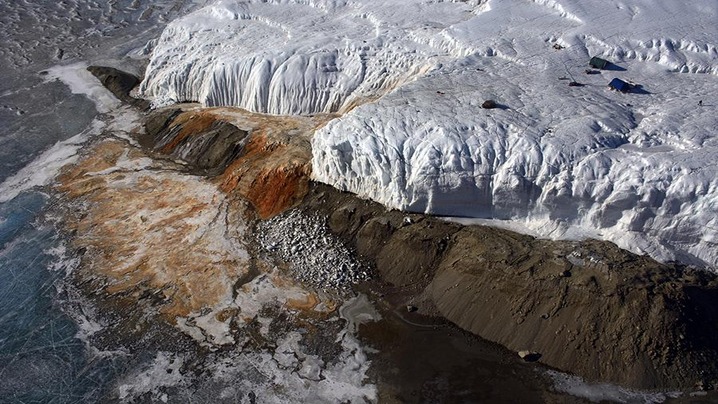
At the edge of Taylor Glacier, rusty-red liquid occasionally stains the ice. The color does not come from blood or red algae. Scientists have traced it to extremely salty, iron-rich water stored beneath the glacier. When that brine reaches oxygen at the surface, dissolved iron oxidizes and produces the red-orange color. The site also interests researchers because microorganisms persist in its cold, dark, salty environment.
2. Sailing stones in Death Valley
Rocks on Racetrack Playa leave long tracks across a dry lakebed, sometimes changing direction. Direct observations finally documented the mechanism: after rare rain, a shallow pond freezes overnight. Sunlight breaks the thin ice into floating sheets, and light winds push those sheets against rocks. The stones slide slowly over softened mud. Visitors should never move rocks or walk on the playa when wet; footprints and tire marks can remain for years.
3. Ocean bioluminescence
A breaking wave can flash electric blue when disturbed microorganisms emit light through a chemical reaction. Bioluminescence occurs in many marine organisms and can serve communication, defense, camouflage, or hunting. Coastal displays vary with species, water conditions, and season, so no beach can guarantee a show. Some blooms can also involve harmful algae, making local public-health guidance more reliable than social-media travel claims.
4. The aurora
Auroras form when charged particles associated with the solar wind interact with Earth’s magnetic environment and upper atmosphere. Different gases and altitudes help produce different colors, most commonly green. Activity is strongest nearer the polar regions, but powerful geomagnetic storms can make auroras visible much farther away. Space-weather forecasts can improve the odds of seeing one, though clouds and artificial light still matter.
5. Lenticular clouds
These smooth, lens-shaped clouds can resemble stacked saucers. They commonly form when stable, moist air flows over mountains, creating standing waves downwind. Air cools and condenses near a wave crest, then warms and evaporates as it descends. The cloud can appear stationary even while air moves rapidly through it. Pilots take the associated turbulence seriously, especially near mountainous terrain.
6. Columnar basalt
Places such as Giant’s Causeway display tightly packed stone columns, many with six sides. The pattern develops as thick lava cools, contracts, and fractures. Similar jointing appears in volcanic landscapes worldwide; the geometry reflects physical stress rather than deliberate construction. Local traditions give these formations cultural meaning, while geology explains how the rock acquired its shape.
7. Wave Rock, Australia
Western Australia’s Wave Rock is a curved granite cliff on Hyden Rock. Weathering and water erosion undercut and rounded the face, while mineral deposits created vertical bands of color. Geoscience Australia reports that the underlying rock is more than 2.7 billion years old. Its surf-like profile is therefore a snapshot of extremely slow change, not a frozen ocean wave.
How to experience rare phenomena responsibly
- Check official park, weather, and hazard notices before traveling.
- Use established paths and avoid touching fragile surfaces.
- Treat Indigenous and local cultural interpretations with respect.
- Remember that dramatic photographs may use long exposures or enhanced color.
The most satisfying explanation is often not that nature performed a trick, but that ordinary processes aligned in an extraordinary way.
Sources: U.S. National Science Foundation; National Park Service; NOAA Ocean Exploration; Geoscience Australia.