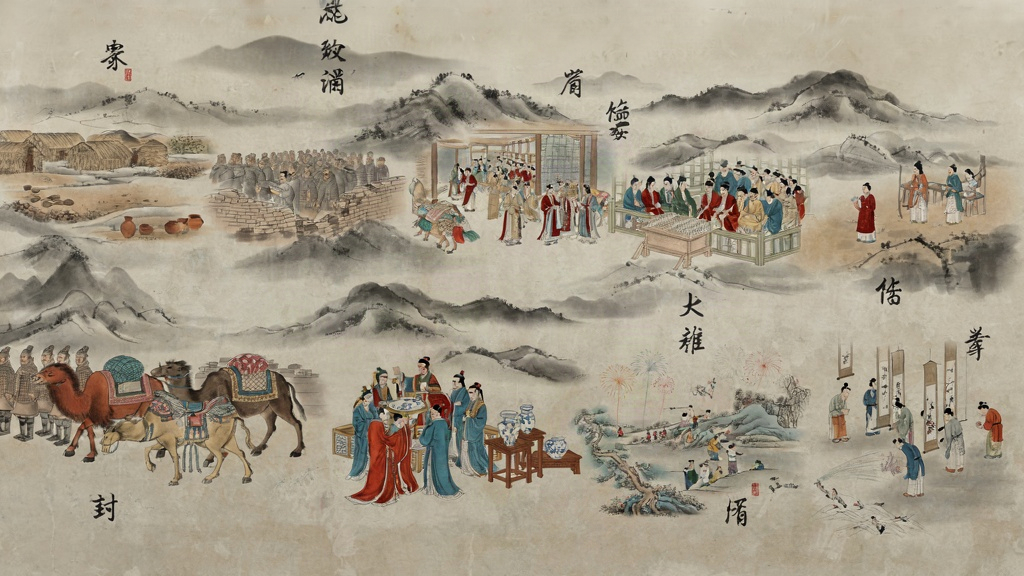
The history of Ancient China spans thousands of years, marked by the rise and fall of powerful ruling families known as dynasties. These dynasties shaped Chinese culture, philosophy, governance, and technology, leaving behind a legacy that influences the modern world. Here is a comprehensive overview of the foundational dynasties of Ancient China, exploring their unique characteristics, achievements, and contributions to human civilization.
Xia Dynasty (c. 2070 – 1600 BCE)
The Xia Dynasty is traditionally regarded as the first dynasty in Chinese history. For centuries, historians debated whether it actually existed or was purely mythological. Modern archaeological excavations at Erlitou suggest that a highly organized society did exist during this bronze-age period. The Xia are credited with establishing the hereditary monarchy system in China and developing early flood-control irrigation systems along the Yellow River.
Shang Dynasty (c. 1600 – 1046 BCE)
The Shang Dynasty provides the earliest written records of Chinese history. Archaeologists discovered these records etched on oracle bones—animal bones and turtle shells used for divination.
· Key Properties: The Shang civilization was deeply religious, practicing ancestor worship and complex ritual sacrifices.
· Major Achievements: They mastered advanced bronze metallurgy, creating intricate ritual vessels and weapons. They also developed a lunar calendar and a highly sophisticated writing system that serves as the direct ancestor of modern Chinese characters.
The Era of Philosophical Transformation
Zhou Dynasty (c. 1046 – 256 BCE)

The Zhou Dynasty holds the record as the longest-ruling dynasty in Chinese history. To justify overthrowing the Shang, the Zhou introduced the Mandate of Heaven. This political concept asserted that a king ruled with divine approval, but if he became corrupt, Heaven would withdraw the mandate, leading to his overthrow.
· Feudal System: The Zhou used a decentralized, feudal system of government (Fengjian), granting land to noble relatives. Over time, these nobles grew more powerful than the king, causing the dynasty to fracture into two distinct eras: the Spring and Autumn Period and the Warring States Period.
· The Hundred Schools of Thought: Despite the constant warfare of the later Zhou era, this was the golden age of Chinese philosophy. It gave birth to Confucianism, which emphasized social order and filial piety, and Daoism, which focused on living in harmony with nature.
Imperial Unification and Golden Ages
Qin Dynasty (221 – 206 BCE)
Though it lasted only 15 years, the Qin Dynasty was monumentally important. Qin Shi Huang conquered the warring states and became the first official Emperor of a unified China.
· Governance: The Qin replaced feudalism with a strict, centralized philosophy called Legalism, which relied on absolute state control and harsh punishments.
· Standardization: The emperor unified the nation by standardizing Chinese script, currency, weights, measures, and even axle widths for carts.
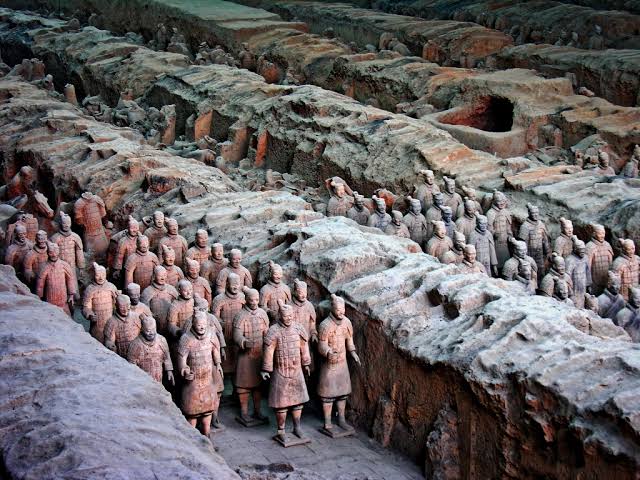
· Monumental Projects: The Qin connected existing regional walls to form the first iteration of the Great Wall of China. They also constructed the world-famous Terracotta Army to guard the emperor in the afterlife.
Han Dynasty (202 BCE – 220 CE)

Following the rapid collapse of the harsh Qin regime, the Han Dynasty emerged, launching a 400-year golden age of prosperity and stability. The Han retained the centralized administrative structure of the Qin but replaced Legalism with Confucianism as the official state ideology.
· The Silk Road: Under Emperor Wu, China expanded its borders and established the Silk Road, a vast trade network connecting Asia with Europe and Africa, facilitating cultural and commercial exchange.
· Inventions: The Han period was a time of immense scientific progress. The Chinese invented paper, the seismograph to detect earthquakes, the wheelbarrow, and advanced agricultural tools.
The Dynastic Cycle and Legacy
Ancient Chinese history follows a predictable pattern known as the dynastic cycle. A new dynasty restores peace, protects citizens, and claims the Mandate of Heaven. Over time, the ruling family grows corrupt, taxes increase, and infrastructure decays. This vulnerability triggers natural disasters, famines, and foreign invasions, which the people view as a sign that the Mandate of Heaven has been lost. Finally, a rebellion overthrows the old regime, and a new dynasty takes its place.
The foundational era of these early dynasties established the core values of Chinese identity. The social structures, philosophies, and administrative systems perfected by the Zhou, Qin, and Han dynasties served as the blueprint for all subsequent Chinese empires for the next two millennia.