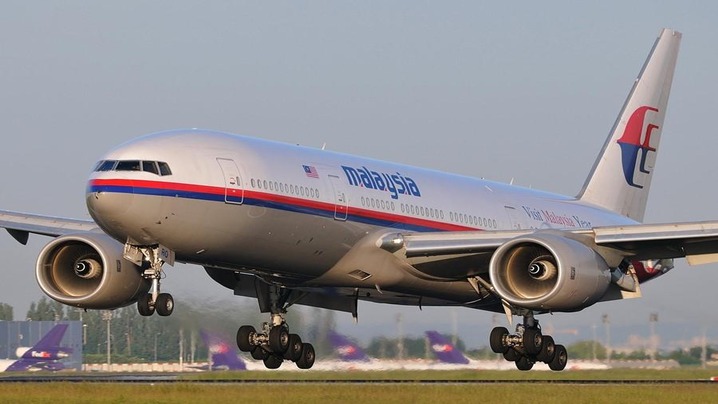
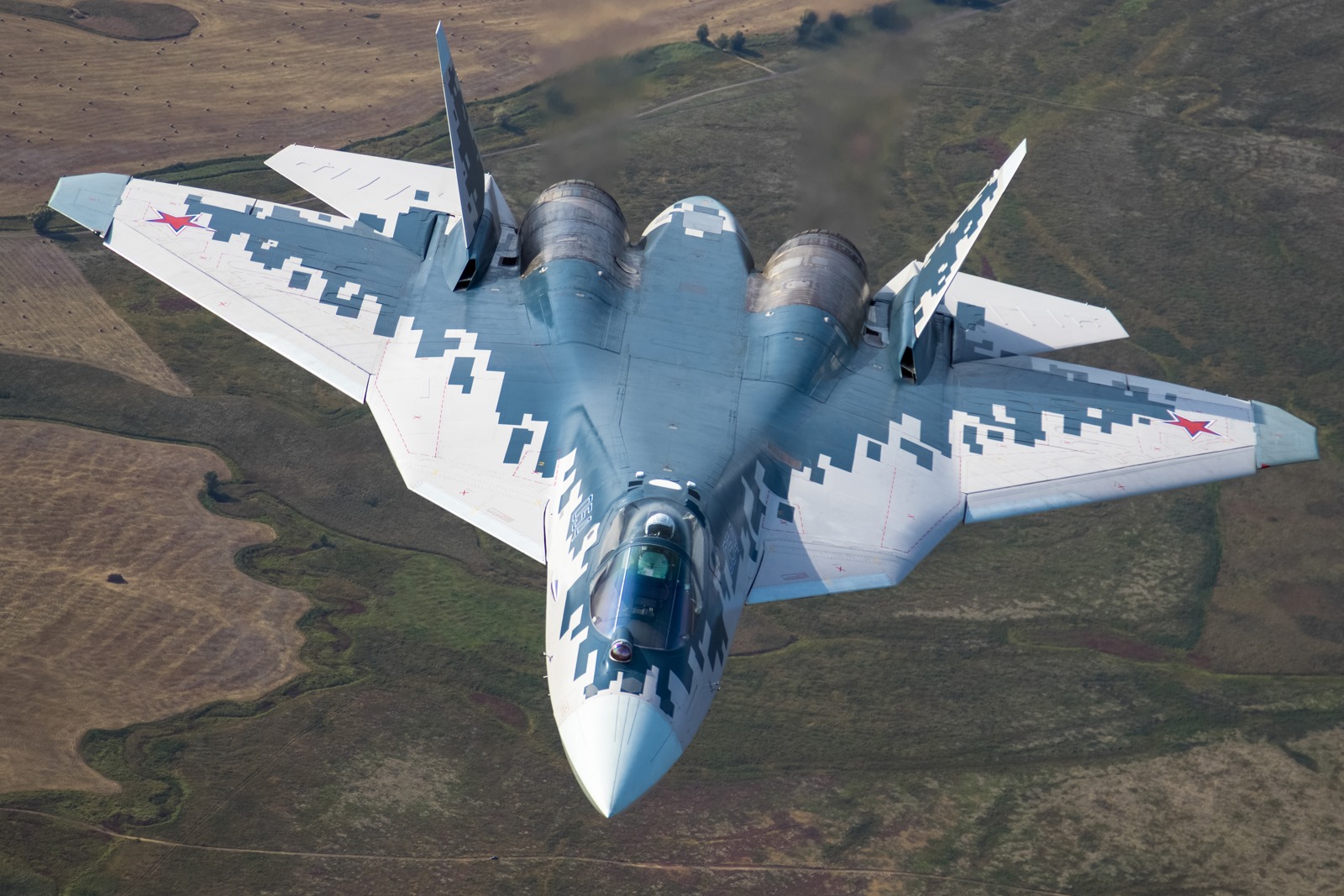
Comparisons between Russia’s Su-57 and the U.S.-led F-35 often present a tidy winner. Public evidence does not support that certainty. Modern combat aircraft operate as parts of larger systems, many decisive characteristics are classified, and the two programs were built at different scales for different force structures. A responsible comparison can describe missions, design priorities, and documented program realities without inventing a simulated duel.
Different programs, overlapping labels
Both aircraft are described by their sponsors as fifth-generation multirole fighters with reduced observability, advanced sensors, and the ability to attack air and surface targets. The F-35 is a family of three variants: the conventional F-35A, short-takeoff/vertical-landing F-35B, and carrier-based F-35C. It was designed around joint and allied use, data sharing, sensor fusion, and large-scale production.
The Su-57 is a Russian twin-engine multirole fighter. Official Russian sources emphasize maneuverability, reduced observability, operation in contested electronic environments, and continued modernization. Development has included work on a newer engine and a two-seat derivative. Publicly announced capabilities should be treated as manufacturer or state claims unless independently demonstrated.
Stealth is more than a shape
“Stealth” is not invisibility and cannot be summarized by one publicly verifiable number. Detectability varies with radar frequency, aspect, configuration, coatings, thermal signature, electronic emissions, and the sensors searching for the aircraft. External stores can trade low observability for payload. Maintenance quality also matters. Because authoritative radar-cross-section data are classified, confident claims that one aircraft will always detect the other first are speculation.
Sensors, software, and networks
The U.S. Air Force describes the F-35A around integrated avionics, sensor fusion, secure data sharing, and situational awareness. That concept treats the aircraft as a node that gathers and distributes information. The value depends not only on onboard hardware but also on software, mission data, communications, supporting aircraft, and trained operators.
Russia describes the Su-57 as capable of operating against air, ground, and maritime targets in difficult weather and jamming. Far less independently verifiable information is public about its software maturity, sensor performance, and fleet-wide networking. Comparing brochure feature lists therefore creates false equivalence.
Scale and sustainment
The F-35’s clearest advantage is program scale: hundreds of U.S. aircraft plus a large international fleet, established training pipelines, shared upgrades, and a broad supply network. Scale, however, does not guarantee readiness. The U.S. Government Accountability Office continues to report high sustainment costs, spare-parts constraints, and performance below program goals. Those official findings are essential context missing from promotional descriptions.
The Su-57 fleet is much smaller, which limits public evidence about operational availability and complicates comparisons of sortie generation, training depth, and upgrade capacity. A small fleet may introduce useful capabilities, but it cannot automatically provide the geographic presence or learning base of a multinational program.
Questions that matter more than “who wins?”
- What mission is assigned, and what supporting sensors, tankers, defenses, and command networks are available?
- How many aircraft and trained crews are ready at the required location?
- Can maintainers, depots, and suppliers sustain operations over time?
- Which claims come from audited oversight, and which come from a manufacturer or government promoting its own system?
On public evidence, the F-35 is the more mature and widely fielded international system, while the Su-57 remains a smaller program undergoing development and modernization. That is a program-level judgment, not a prediction about a hypothetical encounter. Real outcomes depend on context that public specification tables cannot capture.
Sources: U.S. Air Force F-35A fact sheet; U.S. GAO F-35 sustainment review; Rostec on Su-57 engine testing; UAC on the Su-57 two-seat prototype.