Not “fake kings,” but political claimants
The men commonly called false tsars were not merely eccentric impostors. Their claims became dangerous because they appeared during crises when succession, legitimacy, war, and social grievance had weakened confidence in the state. Whether subjects literally believed each story is only part of the question. A pretender could serve as a banner under which nobles, foreign powers, Cossacks, peasants, and townspeople pursued different goals.
1. False Dmitry I and the broken succession
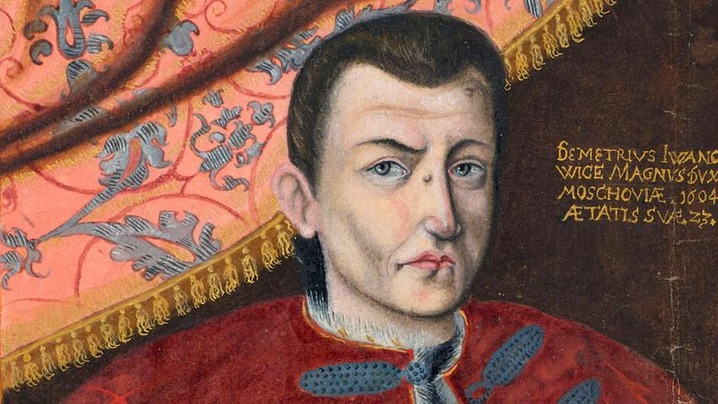
Ivan IV’s son Dmitry died as a child in Uglich in 1591. When Tsar Fyodor I died without an heir in 1598, the centuries-old Rurik dynasty ended and Boris Godunov became tsar. Famine from 1601 to 1603, elite rivalry, and uncertainty about the child’s death created fertile ground for a claimant who said he had survived.
The first False Dmitry appeared in the Polish-Lithuanian Commonwealth and gathered support among magnates and others who saw advantage in his campaign. He entered Russia in 1604. Boris Godunov’s sudden death the next year transformed the contest: Dmitry reached Moscow and was crowned. His reign lasted less than a year. Opposition among boyars, hostility toward his Polish connections, and tension surrounding his marriage to Marina Mniszech culminated in an uprising and his killing in 1606.
His brief success reveals that royal identity was political as well as biological. Recognition by armies, elites, church figures, and urban crowds could temporarily make a disputed story function as government.
2. False Dmitry II and a rival court
A second claimant emerged in 1607 and was accepted by Marina as her supposedly surviving husband. Unlike the first, he never securely ruled from the Kremlin. He established a rival center at Tushino near Moscow, complete with administrators and supporters. For a time, Russia effectively had competing courts claiming authority.
His coalition joined dissatisfied Russian factions with Polish-Lithuanian forces, but its members did not share one objective. Allegiance shifted as military conditions and negotiations changed. The Tushino camp weakened, the claimant fled, and he was killed in 1610. The episode shows how a royal name could coordinate a movement without producing a stable state.
3. Emelian Pugachev as “Peter III”
More than a century later, the Don Cossack Emelian Pugachev claimed to be Emperor Peter III, who had been deposed and killed in 1762. Beginning in 1773, his rebellion drew support from Cossacks, peasants, factory workers, and some non-Russian communities across the Volga and Ural regions.
The claim did more than disguise Pugachev’s identity. It supplied a familiar language of legitimate rule: a “true” sovereign could be imagined as freeing subjects from abusive officials, landlords, taxation, and service obligations. The movement captured towns and threatened important centers before imperial forces defeated it. Pugachev was taken to Moscow and executed in 1775.
Why pretenders could attract followers
- Unclear succession: sudden deaths and disputed dynastic transitions made survival stories harder to dismiss.
- Limited information: most subjects had never seen the ruler, and official news traveled unevenly.
- Political usefulness: elites and foreign sponsors could support a claimant without privately accepting every detail.
- Popular monarchism: anger at local oppression could coexist with faith in an imagined just ruler.
- Coalition language: a royal identity allowed groups with different grievances to act under one name.
Reading the label carefully
“Pretender” describes a claim rejected by the regime and most later historians; it should not make the social conflict disappear. The central historical question is not how gullible people were. It is why a particular identity could make rebellion, intervention, or elite defection seem legitimate at a particular moment.
Sources: Library of Congress: Russia, a Country Study; Boris Yeltsin Presidential Library: Pugachev collection item; Encyclopaedia Britannica: Time of Troubles; Encyclopaedia Britannica: Yemelyan Pugachov.