Beauty is personal, and “castle” covers structures built for very different purposes. Some were fortresses; others were palaces designed to project legitimacy, stage court life, or create a romantic fantasy of the past. This selection is not a universal ranking. It highlights ten places that reward attention to architecture, landscape, and preservation.
1. Himeji Castle, Japan
Himeji’s white plastered walls, layered roofs, gates, and twisting approaches combine visual unity with defense. UNESCO identifies it as the finest surviving example of early seventeenth-century Japanese castle architecture. Its timber construction and 82 surviving buildings make the complex far richer than its famous main keep alone.
2. Krak des Chevaliers, Syria
This Crusader-period fortress was developed in stages and later modified under Mamluk control. Concentric defenses, towers, halls, and its commanding location show how architecture responded to changing warfare. Syria’s conflict has also made conservation and accurate damage assessment part of the site’s modern story.
3. Edinburgh Castle, Scotland
Set on volcanic rock above the city, Edinburgh Castle combines a defensible position with centuries of royal, military, and national symbolism. Buildings from different periods reveal continual adaptation rather than one perfect medieval design. Its prominence demonstrates how landscape can become part of political architecture.
4. Neuschwanstein, Germany
Commissioned by King Ludwig II in the nineteenth century, Neuschwanstein is not a medieval fortress. It is a historicist retreat inspired by earlier architecture, theater, legend, and music. UNESCO added Ludwig’s palace group to the World Heritage List in 2025, recognizing their carefully staged artistic worlds and period technology.
5. Alcázar of Segovia, Spain
Rising above the meeting of two rivers, the Alcázar reflects medieval origins and repeated remodeling. Its pointed roofs and cliff-edge silhouette are memorable, but the building’s importance also comes from its changing functions as royal residence, fortress, prison, and military academy.
6. Château de Chambord, France
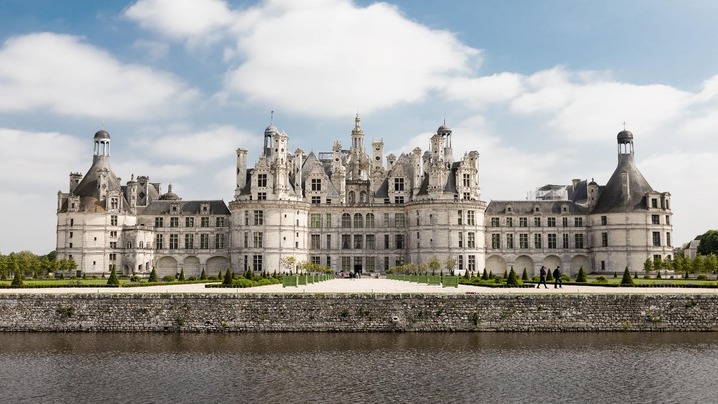
Chambord expresses Renaissance royal ambition through a vast plan, richly modeled roofline, and celebrated double-helix staircase. Although it borrows defensive forms, it was designed principally for status and residence rather than sustained siege warfare. The surrounding estate is integral to the experience.
7. Prague Castle, Czechia
Prague Castle is a large precinct rather than a single building. Palaces, churches, courtyards, and fortifications accumulated over centuries, with St. Vitus Cathedral dominating the skyline. The ensemble shows how a seat of rule can evolve while remaining central to a city’s identity.
8. Elmina Castle, Ghana
Elmina is architecturally imposing, but describing it only as beautiful would erase its role in the Atlantic slave trade. Built by the Portuguese and later controlled by the Dutch and British, it confined enslaved Africans before forced transportation. Visiting requires attention to testimony, violence, and memory.
9. Mehrangarh Fort, India
Massive walls rise above Jodhpur, enclosing gates, courtyards, palaces, and museum collections. Fine stone carving contrasts with the fortress’s scale. The site illustrates how defensive architecture and elite domestic display could coexist within one complex.
10. Malbork Castle, Poland
The Teutonic Order’s brick complex expanded into a monumental fortified monastery and administrative center. Its scale and restoration history make it important for understanding both medieval power and modern conservation. Rebuilding after wartime destruction is part of what visitors see today.
How to visit thoughtfully
- Check official opening and conservation information before travel.
- Look beyond the main façade to water systems, service spaces, and construction phases.
- Ask who built, funded, maintained, and was displaced or confined by the site.
- Respect areas used for worship, government, or commemoration.
Castles endure because later generations continually decide what to preserve and how to interpret it. Their strongest stories combine visual impact with honest history.
Sources: UNESCO: Himeji-jo; UNESCO: Palaces of Ludwig II; UNESCO: Segovia; UNESCO: Ghana forts and castles; UNESCO: Malbork.