
Russian and Soviet rifles are often discussed through hype, battlefield mythology, or imprecise labels. The term “AK-47,” for example, is routinely applied to many rifles that are actually AK, AKM, AK-74, or foreign derivatives. This overview focuses on historical development and identification at a high level. It does not rank lethality or provide instructions for use.
AK: the original production pattern
The rifle developed from Mikhail Kalashnikov’s postwar design work entered Soviet production at the end of the 1940s. Early production versions used both stamped and later milled receivers as manufacturing methods evolved. Its significance lay in combining selective fire with an intermediate cartridge in a package suitable for mass issue. The familiar “AK-47” name is useful in popular conversation, but specialists distinguish the prototype designation from the production AK.
AKM: manufacture simplified
Adopted around the end of the 1950s, the AKM returned to a stamped receiver and incorporated changes that reduced weight and supported efficient mass production. It became one of the most widely distributed Soviet rifle patterns and was manufactured or copied in many countries. That global production is why visual identification requires caution: markings, receiver details, and national variations matter more than a generic silhouette.
AK-74: a smaller-caliber transition
The Soviet Union adopted the AK-74 in the 1970s with a smaller 5.45×39 mm cartridge. The rifle retained the broad Kalashnikov operating concept while introducing a new magazine profile and other visible changes. Later versions, including the AK-74M, consolidated features for general service. The transition reflected a wider international move toward smaller-caliber, high-velocity service ammunition during the Cold War.
AN-94: ambitious but limited
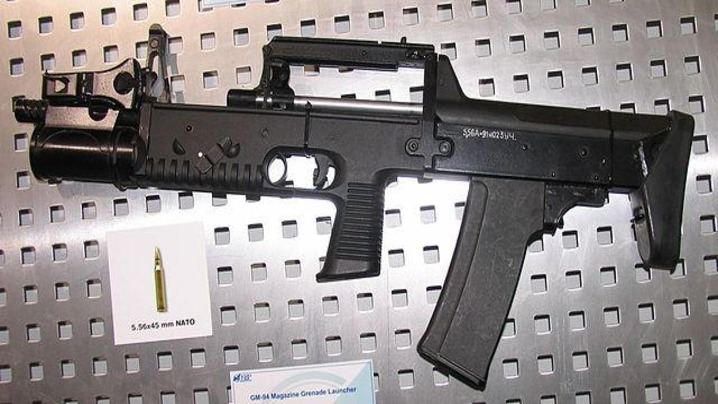
The AN-94 emerged from a late Soviet competition and was adopted in Russia during the 1990s. It used a mechanically complex system intended to improve the placement of the first two rounds in a burst. That engineering ambition came with cost, complexity, and training demands. It never displaced the Kalashnikov family as the dominant general-issue platform, making it historically interesting precisely because technical novelty did not translate into broad adoption.
AK-12: modernization of a familiar system
The AK-12 represents Russia’s effort to update the Kalashnikov pattern for contemporary accessories, ergonomics, and production requirements. Publicly observed examples have changed across development and service, so photographs labeled “AK-12” may show different generations. Recent Small Arms Survey research has documented AK-12-pattern rifles among weapons seized from illicit trafficking in Ukraine, while noting that older AK-74-pattern rifles remained much more common in the reviewed records.
What these five designs reveal
- Manufacturing practicality can matter more than an innovative mechanism.
- Military adoption does not mean immediate or universal replacement of older stocks.
- Export copies and licensed production complicate names, totals, and origin claims.
- Weapons persist long after their original state disappears, creating stockpile and diversion risks.
A responsible history therefore connects design to institutions: factories, procurement, doctrine, alliances, exports, and arms-control challenges. It also avoids treating weapons as isolated consumer products. Their historical importance includes the conflicts in which they circulated and the long-term burden created when state stockpiles move into illicit markets.
Terminology also matters for public understanding. Precise identification supports historical research, stockpile accounting, tracing, and efforts to prevent weapons from moving into unauthorized hands.
Sources: Small Arms Survey identification handbook; Small Arms Survey research note; Small arms production in Russia; Small Arms Survey 2025 Ukraine report.